The moment you open an oven door and receive that golden, intoxicating wave of toasted sugar and caramelizing butter, something primal and deeply comforting activates. Baking is equal parts precise laboratory science and soul-nourishing culinary art. While cooking allows for whimsical on-the-fly adjustments, baking demands respect for chemical reactions, moisture dynamics, and thermal physics.
Mastering your home oven requires more than following a recipe; it demands an understanding of how ingredients interact under heat. Whether you are seeking a foundational intro to baking or aiming to refine your current kitchen repertoire, mastering these core principles will transform your home kitchen into an artisan bakery.
1. The Foundation: Baking 101
Before turning on your oven, you must establish control over your environment, tools, and ingredients. Minor variances in temperature, flour density, or ambient humidity can drastically alter the final texture of your baked goods.
Essential Equipment Setup
-
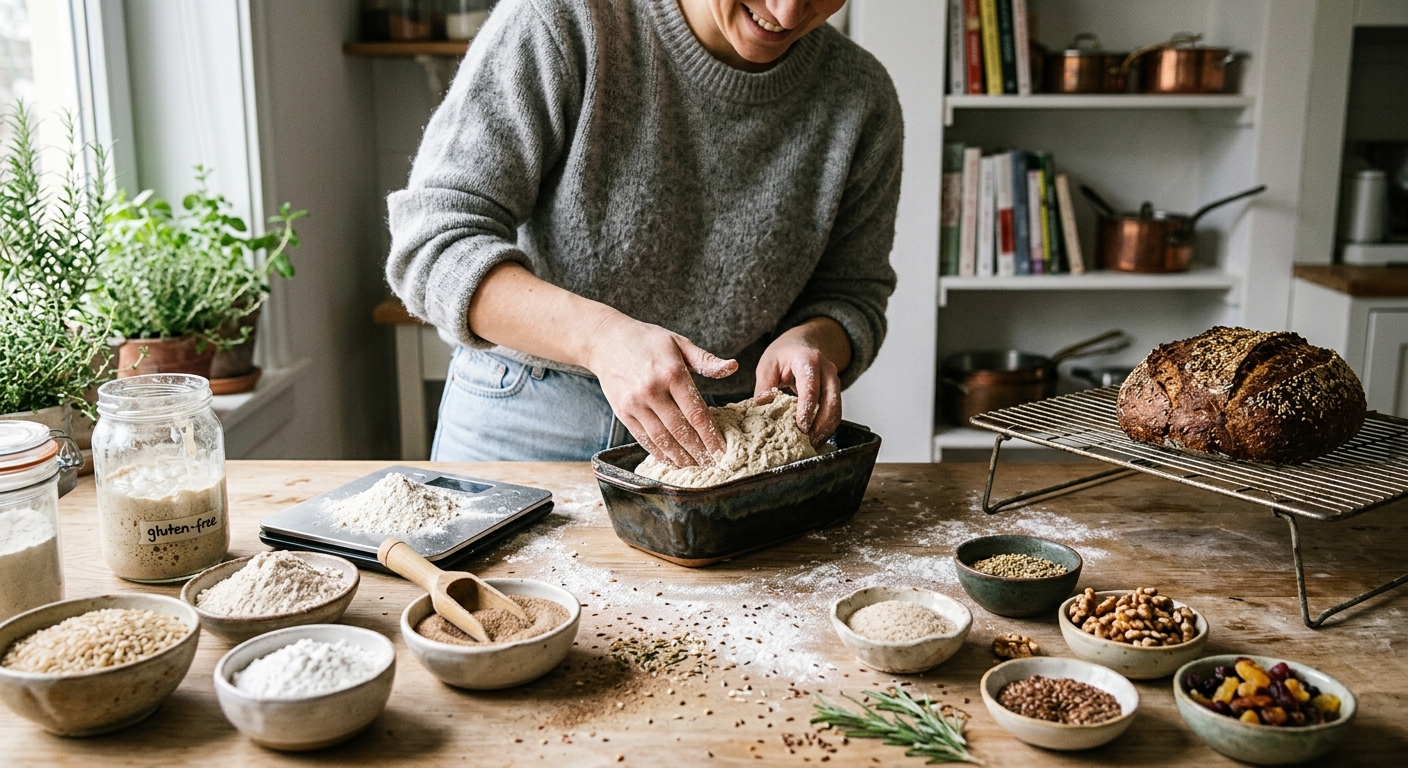
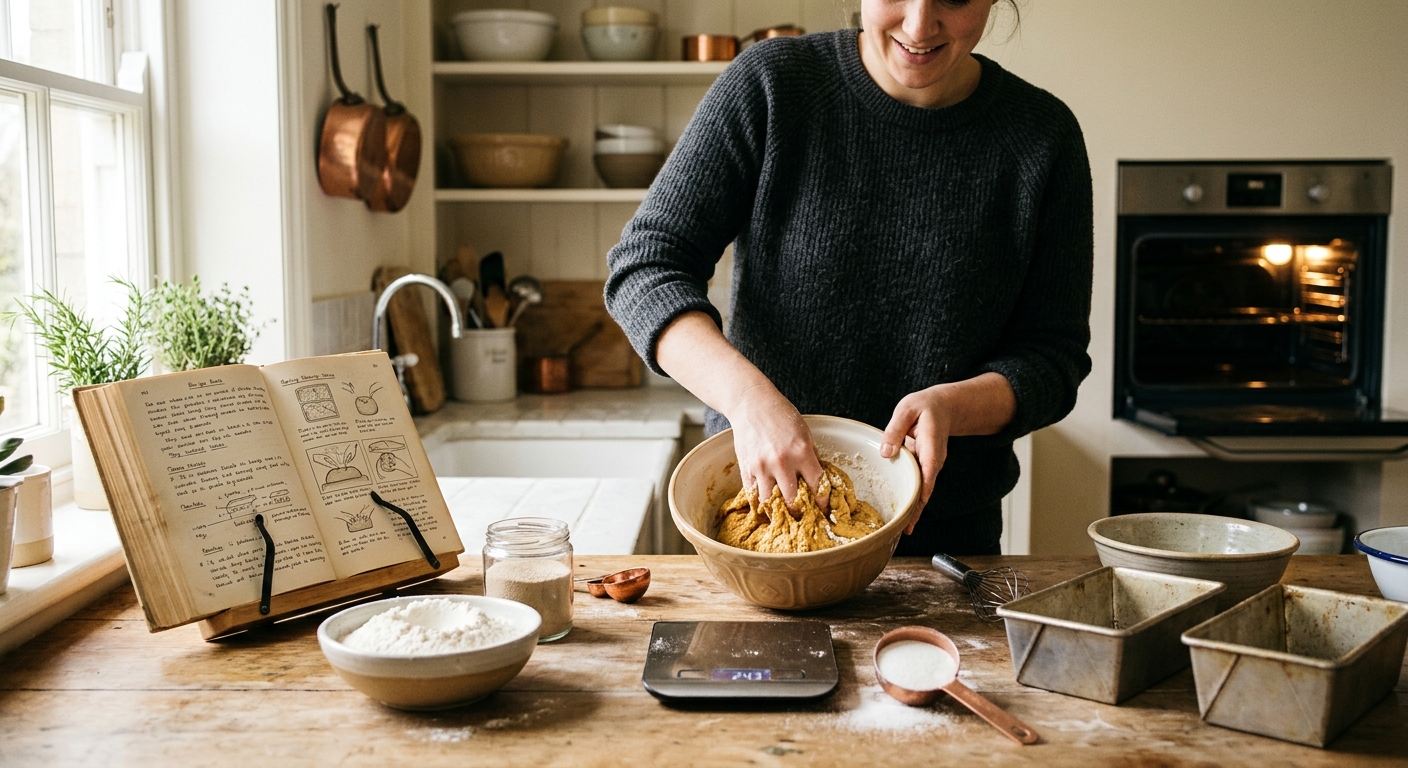
Digital Food Scale: Volume measurements (like cups) are notoriously inaccurate due to how tightly flour packs. Weighing ingredients in grams guarantees absolute consistency every time.
-
Oven Thermometer: Most built-in oven thermostats misreport temperatures by $10^\circ\text{F}$ to $30^\circ\text{F}$. Hanging a mechanical thermometer on the central rack provides an accurate reading.
-
Heavy-Gauge Baking Sheets: Thin aluminum pans warp under high heat, creating uneven hot spots that scorch pastry bottoms before the tops are fully set.
Understanding Key Ingredients
-
Flour (Protein Content): Bread flour contains higher protein levels ($\approx 12\text{–}14\%$), developing dense gluten networks ideal for chewy sourdoughs. Cake flour ($\approx 7\text{–}8\%$) yields tender, delicate crumbs.
-
Fats (Butter vs. Oil): Butter provides flavor and structural air pockets via steam creation during melting. Oil imparts long-lasting moisture, ideal for quick breads and spiced muffins.
-
Leavening Agents: Baking soda requires an acid (such as buttermilk, citrus, or brown sugar) to activate carbon dioxide release. Baking powder contains its own dry acid and activates upon contacting liquid and thermal energy.
Pro Tip: Keep a dedicated baking journal. Document oven rack positions, ambient room temperature, and bake times to track how subtle environment changes affect your recipes.
2. Fundamental Techniques of Baking
Transforming raw batter into structured pastries requires executing specific physical maneuvers with intention. Master these foundational mechanics to execute recipes flawlessly.
+-------------------+------------------------------------+----------------------------------+
| Technique         | Primary Objective                  | Common Pitfall                   |
+-------------------+------------------------------------+----------------------------------+
| Creaming          | Entrap air bubbles within fat      | Overheating butter until greasy  |
| Folding           | Preserve delicate aeration         | Aggressive circular stirring     |
| Blind Baking      | Pre-cook pie crusts to prevent soggy bottoms | Omitting pie weights   |
| Proofing          | Allow yeast fermentation and gas production | Over-proofing into collapse |
+-------------------+------------------------------------+----------------------------------+
The Art of Creaming Fat and Sugar
Creaming room-temperature butter and granulated sugar isn’t merely about mixing; it is a physical process of mechanical aeration. Jagged sugar crystals carve millions of microscopic pockets into the butter matrix. When baked, these pockets trap expanding carbon dioxide, creating light, tender cakes.
Gentle Folding Techniques
When incorporating whipped egg whites or sifted flour into delicate batters, aggressive stirring deflates captured air pockets. Use a flexible silicone spatula, cutting straight down through the center, sweeping along the bottom of the bowl, and folding the batter back over itself while rotating the mixing bowl.
3. Top Baking Tips for Beginners
Stepping into baking can feel overwhelming, but adhering to a few battle-tested rules eliminates common beginner errors.
-
Measure Everything by Weight: Invest in a digital scale. A cup of flour can weigh anywhere from 120 grams to 160 grams depending on how it was scooped, which drastically alters liquid ratios.
-
Bring Ingredients to Room Temperature: Cold eggs or milk added to creame butter cause fats to curdle and break, preventing smooth batter emulsion.
-
Preheat Thoroughly: Allow your oven to preheat for at least 15 to 20 minutes after reaching the target temperature so the walls fully absorb heat energy.
-
Avoid Unnecessary Oven Door Opening: Opening the oven door lets heat escape rapidly, causing temperature drops up to $25^\circ\text{F}$ and risking the collapse of rising cakes or soufflés.
-
Calibrate Your Leavening Agents: Check the expiration dates on baking powder and soda. Old leaveners lose potency, resulting in dense, flat bakes.
4. Crucial Baking Basics for Consistent Results
To achieve predictable success, adopt the habits professional pastry chefs rely on daily.
           +---------------------------------------+
           |       1. Mise en Place Setup          |
           +---------------------------------------+
                               |
                               v
           +---------------------------------------+
           |     2. Temperature Calibration        |
           +---------------------------------------+
                               |
                               v
           +---------------------------------------+
           |     3. Precise Hydration & Mixing     |
           +---------------------------------------+
                               |
                               v
           +---------------------------------------+
           |      4. Controlled Bake & Cooling     |
           +---------------------------------------+
Thermal Management in the Oven
Heat flows via radiation, convection, and conduction inside your oven. Placing pans in the middle rack ensures balanced radiant heat from top and bottom heating elements. For recipes requiring deep browning on the bottom, such as rustic artisan loaves or pizza crusts, place a preheated baking stone on the lowest rack.
Hydration and Gluten Control
Gluten develops when two proteins found in wheat flour—glutenin and gliadin—mix with water and undergo mechanical agitation. Minimal mixing produces soft, crumbly textures suitable for biscuits, while extensive kneading produces elastic structures required for chewy sourdoughs and brioche.
5. Creative Baking Ideas for Beginners
Starting your baking journey with approachable, high-success recipes builds confidence and teaches core skills.
-
Classic Drop Cookies: Perfect for mastering fat creaming, sugar caramelized notes, and precise bake-timing adjustments.
-
Simple No-Knead Focaccia: An easy entry point into yeast doughs, highlighting high-hydration fermentation without complex shaping.
-
Traditional Scones: Demonstrates the technique of cutting cold fat into dry flour, generating flaky layers through steam expansion.
-
Single-Bowl Banana Bread: Teaches the chemical balance between chemical leaveners, liquid fats, and natural fruit sugars.
6. Advanced Tips for Beginner Bakers
Once you master the fundamentals, applying these high-yield kitchen hacks will instantly elevate your baking quality.
Flour Dusting Alternatives
When rolling out cocoa-based cookie doughs or chocolate cakes, dust your surfaces with unsweetened cocoa powder instead of white flour to prevent unsightly chalky white residue.
Thermal Resting for Doughs
Refrigerating cookie dough for 24 to 72 hours before baking allows flour proteins to hydrate completely while enzymes break down complex starches into simple sugars. This resting phase deepens flavor notes into rich caramel and prevents excess spreading.
Restoring Moisture Balance
If a cake cools into a slightly dry texture, brush the sponge layers with a light simple syrup (equal parts sugar and water simmered together) infused with vanilla or citrus zest before frosting.
7. Master-Level Baking Techniques
Moving from novice to advanced baker involves mastering delicate chemical suspensions and precise temperature windows.
Emulsification Mechanics
Batters represent an emulsion of fat and water. Adding eggs too quickly can overload the fat matrix, causing it to separate. Incorporate eggs one at a time at room temperature, beating thoroughly after each addition to create a smooth, stable emulsion.
Maillard Reaction vs. Caramelization
Deep flavor development relies on two distinct thermal processes:
-
Maillard Reaction: Occurs around $280^\circ\text{F}\text{–}330^\circ\text{F}$ as amino acids and reducing sugars react, generating savory, complex toasted notes in bread crusts.
-
Caramelization: Begins around $320^\circ\text{F}$ as pure carbohydrates decompose under heat, creating sweet, buttery flavor profiles.
Master Checklist for Baking Success
-
[ ] Weigh dry and wet ingredients on a calibrated digital scale in grams.
-
[ ] Verify oven accuracy using an independent hanging oven thermometer.
-
[ ] Bring butter, eggs, and dairy liquids to uniform room temperature ($65^\circ\text{F}\text{–}68^\circ\text{F}$).
-
[ ] Space baking sheets evenly inside the oven to allow optimal heat circulation.
-
[ ] Rest finished baked goods on wire cooling racks to prevent condensation buildup beneath crusts.
By internalizing these core fundamentals, applying structured discipline, and remaining open to experimentation, your home kitchen will consistently produce high-quality pastries, breads, and desserts. Happy baking!