Food is one of the most universal forms of human expression. Every culture has developed its own ingredients, cooking methods, traditions, rituals, and ways of bringing people together around a table. Behind these traditions is a fascinating discipline known as culinary arts, a field that combines practical cooking skills with creativity, cultural knowledge, scientific understanding, and hospitality.
A culinary arts introduction provides a useful starting point for understanding what happens behind the scenes of professional food preparation. Culinary arts are not limited to restaurant chefs. The field encompasses bakers, pastry chefs, caterers, private chefs, recipe developers, food stylists, culinary instructors, food researchers, and many other professionals who work with food.
At its core, culinary arts is about transformation. Raw ingredients become finished dishes through careful preparation, controlled heat, seasoning, technique, and presentation. Yet the process can be far more nuanced than simply following a recipe.
A professional culinary artist considers flavor, aroma, texture, color, temperature, nutrition, efficiency, cost, and the expectations of the person who will eventually eat the dish.
That combination of craftsmanship and imagination makes culinary arts an endlessly evolving field.
What Are Culinary Arts?
Culinary arts refer to the professional and creative practice of preparing, cooking, presenting, and serving food. The discipline includes both foundational kitchen techniques and sophisticated approaches to food design.
The scope is remarkably broad.
A culinary professional may spend one morning preparing vegetables and stocks, an afternoon testing recipes, and an evening coordinating a busy restaurant service. Another professional may spend the day producing elaborate pastries, while a private chef might design an individualized menu for a family.
Culinary arts can include:
- Food preparation
- Cooking
- Baking and pastry
- Menu development
- Food presentation
- Recipe creation
- Ingredient selection
- Flavor development
- Food safety
- Kitchen management
- Catering
- Hospitality
- Culinary education
- Food product development
The field also incorporates influences from chemistry, nutrition, agriculture, anthropology, history, and business.
This interdisciplinary character is one reason culinary arts can offer such diverse career opportunities.
Understanding the Culinary Arts Definition
The culinarily definition of the field can be understood through the relationship between food, technique, creativity, and service.
Cooking itself is an ancient human activity, but culinary arts introduce a more deliberate dimension. The culinary professional does not simply heat ingredients until they become edible. Instead, ingredients are selected and transformed according to a desired sensory and cultural outcome.
Consider a simple tomato.
It can be eaten raw with salt and herbs. It can be roasted to intensify sweetness, simmered into a sauce, blended into a soup, fermented, dried, grilled, or incorporated into a complex composed dish.
The ingredient remains fundamentally the same, yet technique changes its character.
This transformation is at the heart of culinary craftsmanship.
What Is Culinary Food Art?
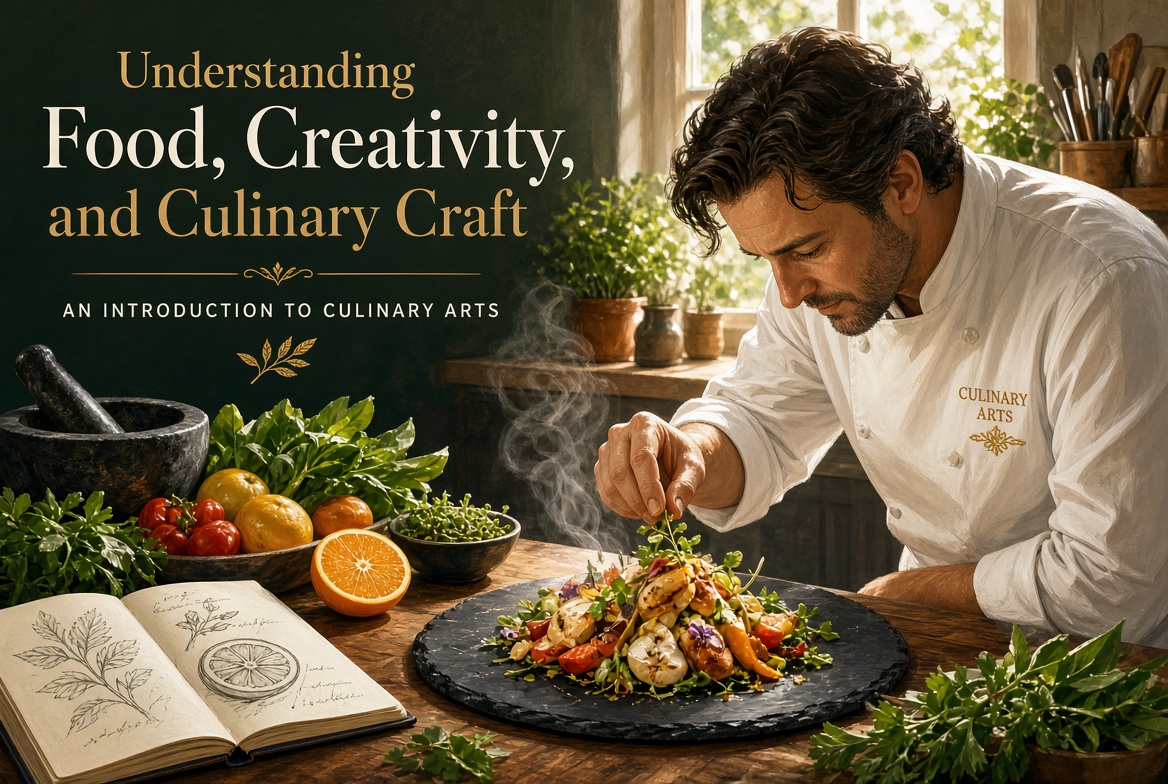
The concept of culinary food art describes the creative use of food, technique, composition, and presentation to produce dishes that appeal not only to taste but also to the eye and other senses.
A beautifully plated dish can resemble a miniature landscape.
Colors are arranged deliberately. Textures create contrast. Sauces form precise patterns. Garnishes introduce aromatic or visual accents. Ingredients are positioned so that the finished plate feels balanced rather than accidental.
Yet culinary food art is not merely decoration.
The most effective presentation connects aesthetics with flavor.
A crisp herb might provide both visual freshness and aromatic intensity. A sauce can create color while supplying acidity or richness. A toasted seed can provide contrast in both texture and appearance.
The strongest culinary compositions therefore have purpose.
The Relationship Between Cooking and Art
Cooking is often described as both a science and an art.
The scientific component involves measurable factors such as temperature, time, ratios, chemical reactions, fermentation, emulsification, and heat transfer.
The artistic component involves intuition, creativity, sensory judgment, cultural expression, and presentation.
A chef can follow the same recipe repeatedly and still produce slightly different results because ingredients vary.
Tomatoes can differ in acidity. Flour can respond differently depending on humidity. Herbs can have varying levels of potency. Meat can differ in tenderness.
Experience allows culinary professionals to compensate for these variations.
This is where technical knowledge meets instinct.
The Foundations of Culinary Arts
Every culinary professional begins with fundamentals.
Knife Skills
Knife skills are among the first abilities taught in many culinary programs.
Professionals learn how to handle knives safely and efficiently while producing consistent cuts such as:
- Dice
- Mince
- Julienne
- Chiffonade
- Brunoise
- Batonnet
- Slices
- Paysanne cuts
Consistent cutting is not simply about appearance.
Ingredients of similar size generally cook more evenly, which can improve both texture and quality.
Mise en Place
Mise en place is a foundational culinary principle.
The French phrase is commonly associated with having ingredients, equipment, and preparations organized before cooking begins.
A well-prepared workstation allows a chef to work efficiently during service.
Ingredients are measured. Vegetables are prepared. Sauces are ready. Equipment is positioned. Garnishes are organized.
The kitchen becomes a carefully orchestrated system rather than a chaotic collection of individual tasks.
Heat Management
Understanding heat is fundamental to cooking.
Different techniques require different temperature levels and methods of heat transfer.
Grilling exposes food to intense direct heat. Roasting uses hot circulating air. Sautéing relies on direct contact between food and a heated cooking surface. Steaming uses moist heat.
A culinary professional learns not only how to apply heat but also how to recognize when food has reached the desired state.
Cooking Techniques in Culinary Arts
Culinary education introduces professionals to numerous cooking techniques.
Sautéing
Sautéing involves cooking relatively small pieces of food quickly in a small amount of fat over relatively high heat.
It is particularly useful for vegetables, seafood, poultry, and other ingredients that benefit from rapid cooking.
Roasting
Roasting uses dry heat and can produce deeply developed flavors through browning and caramelization.
Vegetables, meats, poultry, and many other foods can benefit from roasting.
Braising
Braising combines initial browning with slower cooking in liquid.
This method is particularly effective for tougher cuts because extended cooking can soften connective tissue and produce deeply savory results.
Poaching
Poaching involves gently cooking food in a liquid maintained below a vigorous boil.
It can be particularly useful for delicate proteins and fruit.
Steaming
Steaming exposes food to hot vapor rather than immersing it directly in liquid.
This technique can preserve delicate textures and flavors.
Baking
Baking relies heavily on accurate measurements and controlled temperature.
Bread, pastries, cakes, biscuits, pies, and many desserts depend on carefully controlled ratios and chemical reactions.
Culinary Ingredients and Flavor
Understanding ingredients is just as important as understanding cooking techniques.
Professional culinary training often involves learning how ingredients interact.
Salt can enhance flavor. Acid can brighten a dish. Fat can carry aromas and create richness. Sweetness can soften bitterness or acidity. Herbs and spices introduce aromatic complexity.
Flavor balancing is therefore an exercise in proportion.
A dish that contains excellent ingredients can still fail if its elements are poorly balanced.
Culinary professionals develop their palate through repeated tasting and observation.
Over time, subtle distinctions become easier to recognize.
The Importance of Texture
Flavor receives considerable attention, but texture can be equally important.
Imagine a bowl of soup containing only smooth ingredients. It may be pleasant, but adding toasted seeds, crisp vegetables, shredded meat, or crunchy croutons can introduce another sensory dimension.
Culinary professionals often deliberately combine contrasting textures.
Common textural contrasts include:
- Crisp and creamy
- Tender and crunchy
- Silky and coarse
- Soft and chewy
- Juicy and crisp
Texture contributes to the overall character of a dish and can influence how satisfying it feels.
Food Presentation and Plating
Professional plating requires more than placing food on a plate.
A culinary artist may consider:
- Color
- Proportion
- Height
- Shape
- Negative space
- Texture
- Sauce placement
- Garnish
- Portion size
- Plate shape
Modern plating often emphasizes restraint.
Instead of covering every available surface, chefs may use empty space to focus attention on the principal ingredients.
Traditional cuisines may follow different aesthetic principles, emphasizing abundance, symmetry, communal presentation, or cultural symbolism.
There is no single correct approach.
Presentation should support the identity of the dish.
Culinary Arts and Cultural Heritage
Food is closely connected to history and cultural identity.
Traditional recipes often reflect geography, agriculture, trade, religion, climate, migration, and historical events.
Spices may reveal centuries of trade. Preservation techniques may reflect seasonal scarcity. Bread-making traditions can reveal agricultural patterns.
Culinary professionals who study different cuisines gain more than recipes.
They gain insight into how communities have interacted with their environments and with one another.
This cultural dimension makes culinary arts particularly rich.
Culinary Food Art in Modern Gastronomy
Contemporary gastronomy has expanded the possibilities of food presentation and preparation.
Some chefs experiment with fermentation, dehydration, smoking, gels, foams, powders, infused oils, unusual textures, and unconventional serving vessels.
Others take a different approach, returning to rustic methods and traditional ingredients.
Both directions can be considered culinary artistry.
Innovation does not always mean technological complexity.
Sometimes the most compelling culinary work comes from returning to an old technique and executing it with exceptional precision.
The Science Behind Culinary Arts
Culinary professionals benefit from understanding the science behind cooking.
Heat causes proteins to change structure. Starches absorb water and gelatinize. Sugars caramelize. Proteins and sugars participate in browning reactions that create complex aromas and colors.
Emulsification is another important concept.
Mayonnaise, hollandaise, vinaigrettes, and other preparations depend on bringing together ingredients that would otherwise separate.
Fermentation introduces another fascinating dimension.
Microorganisms can transform ingredients into foods with distinctive flavors and textures, including bread, yogurt, cheese, pickles, and other fermented preparations.
Understanding these processes allows culinary professionals to troubleshoot rather than merely follow instructions.
Baking and Pastry as Culinary Disciplines
Baking and pastry deserve special recognition within culinary arts.
Pastry professionals may work with:
- Bread
- Cakes
- Cookies
- Tarts
- Pies
- Chocolates
- Custards
- Mousses
- Croissants
- Confections
Precision is especially important.
A small alteration in flour, liquid, fat, sugar, or leavening can dramatically affect the finished product.
Temperature is equally consequential.
Chocolate requires careful handling. Yeast depends on appropriate conditions. Butter behaves differently at different temperatures.
Pastry therefore combines creativity with remarkable technical exactitude.
Culinary Arts in Professional Kitchens
Professional kitchens operate through teamwork.
A restaurant kitchen may contain multiple stations, each with distinct responsibilities.
One professional may prepare sauces. Another may manage vegetables. Another may specialize in proteins. A pastry team may operate separately.
Communication becomes essential.
During a busy service, conversations may be brief and highly specific. Timing must be coordinated across multiple dishes.
This environment requires discipline.
A talented cook who cannot communicate or maintain organization may struggle despite possessing excellent technical skills.
Culinary Education and Training
People can enter culinary careers through several routes.
Formal culinary schools offer structured instruction in cooking, baking, food safety, menu planning, kitchen operations, and hospitality.
Vocational programs can provide practical training, while apprenticeships allow students to learn directly in professional kitchens.
Others begin as kitchen assistants and gradually acquire expertise through experience.
Each route has advantages.
Formal education can provide theoretical foundations and structured practice. Professional experience provides exposure to real service conditions, customer expectations, operational pressures, and teamwork.
Many successful culinary professionals combine both.
Careers in Culinary Arts
The culinary field extends well beyond the conventional restaurant chef.
Potential careers include:
- Executive chef
- Sous chef
- Chef de partie
- Pastry chef
- Baker
- Private chef
- Personal chef
- Catering chef
- Recipe developer
- Food stylist
- Culinary instructor
- Research chef
- Food product developer
- Restaurant consultant
- Culinary entrepreneur
Some professionals eventually open their own restaurants, bakeries, catering companies, food trucks, or specialty food brands.
Others transition into education, media, publishing, or corporate food development.
Skills Needed in Culinary Arts
A successful culinary professional develops a combination of technical and interpersonal skills.
Technical Skills
Technical abilities can include:
- Knife handling
- Cooking methods
- Baking
- Sauce preparation
- Food preservation
- Plating
- Recipe execution
- Ingredient handling
- Food safety
Sensory Skills
Professionals also develop sensory awareness.
They learn to identify subtle changes in aroma, taste, texture, appearance, and temperature.
Organizational Skills
A professional kitchen depends heavily on organization.
Ingredients, equipment, recipes, preparation schedules, inventory, and cleaning routines must all be coordinated.
Communication Skills
Cooking is frequently collaborative.
Clear communication improves efficiency and helps prevent errors.
Creative Skills
Creativity encourages culinary professionals to experiment, develop new dishes, and reinterpret established traditions.
Food Safety and Culinary Responsibility
Food safety is an essential component of culinary professionalism.
A culinary worker must understand proper storage, temperature control, hygiene, cleaning, cross-contamination prevention, and allergen management.
These responsibilities protect both customers and colleagues.
Professional cooking is therefore not solely about producing delicious food.
It is also about producing food responsibly.
Sustainability in Culinary Arts
Modern culinary practice increasingly considers sustainability.
Chefs and food businesses may seek to reduce waste by using more of each ingredient, improving portion control, selecting seasonal produce, and exploring preservation techniques.
Root-to-stem and nose-to-tail approaches can encourage more complete use of ingredients.
Local sourcing can also reduce transportation requirements while supporting regional producers, although the environmental impact varies according to the specific ingredient and supply chain.
Sustainability can therefore become part of culinary creativity.
An ingredient that might previously have been discarded can sometimes become a stock, sauce, garnish, pickle, or another useful preparation.
The Role of Hospitality
Culinary arts are closely connected to hospitality.
Food is prepared for people.
That means culinary professionals need to understand the expectations of guests, customers, clients, or communities.
A successful dining experience can involve much more than flavor.
Temperature, timing, presentation, atmosphere, service, and personalization can all influence how a meal is perceived.
This is why culinary professionals often work closely with front-of-house teams.
The kitchen creates the food, while the broader hospitality operation shapes the experience surrounding it.
Why Culinary Arts Continue to Evolve
Culinary arts are never static.
Ingredients change. Technology develops. Dietary preferences evolve. New restaurants emerge. Traditional techniques are rediscovered. Global travel introduces chefs to unfamiliar flavors and methods.
Social media and digital publishing have also transformed culinary communication.
Recipes, techniques, restaurant concepts, and food traditions can now travel around the world almost instantly.
Yet the fundamentals remain remarkably durable.
Good ingredients still matter.
Proper technique still matters.
Seasoning still matters.
Hospitality still matters.
The tools may change, but the essential relationship between food and people remains.
Building a Culinary Career
For someone considering a culinary career, the journey often begins with simple fundamentals.
Learn to handle a knife properly.
Understand basic cooking methods.
Taste ingredients carefully.
Practice recipes repeatedly.
Study food safety.
Observe experienced professionals.
Ask questions.
Develop patience.
Over time, these individual skills become interconnected.
A cook begins to understand not merely how to prepare a dish but why each step matters.
That transition—from following instructions to understanding principles—is one of the most significant stages in culinary development.
Conclusion
A culinary arts introduction reveals a discipline that is simultaneously practical, creative, scientific, cultural, and deeply human.
The culinarily definition of culinary arts extends far beyond cooking. It encompasses ingredient preparation, heat management, flavor development, food presentation, baking, menu creation, food safety, hospitality, and professional kitchen organization.
Meanwhile, culinary food art demonstrates how cooking can become a form of creative expression. Through color, texture, composition, aroma, and technique, culinary professionals can transform ordinary ingredients into dishes that are visually compelling and gastronomically memorable.
The field offers an extraordinary range of possibilities. A person may begin with basic kitchen skills and eventually become a chef, pastry specialist, private dining professional, culinary educator, recipe developer, food stylist, researcher, consultant, or entrepreneur.
At its heart, culinary arts is about transformation and connection.
Ingredients are transformed through technique. Recipes carry cultural memory. Presentation communicates creativity. Hospitality turns food into an experience.
And every carefully prepared dish offers a small reminder that cooking, when approached with knowledge and imagination, can be much more than a daily necessity—it can become a craft, a profession, and an enduring form of human expression.